

Every once in a while I do a survey asking for knitting questions.
Without fail, there’s one question that comes up frequently EVERY time.
There have been a few attempts to make this process easier over the years but each has their drawbacks.
Let’s take a look at some common ways to solve this problem.
The Craft Yarns Council Yarn Weight Standards
Back in 1981, a bunch of companies in the yarn world got together to form an organization that would help standardize terms and measurements across the industry.
Out of this came the famous Yarn Weight Standards.
You have probably seen these symbols on most yarns found in the big box craft stores like Michaels, A.C. Moore, or Hobby Lobby.

These symbols are meant to be an easy way to help substitute yarn within a pattern. If the pattern calls for a #3 yarn, then you can use any yarn that has the 3 symbol.
Easy peasy.
Well…not quite.
You see yarns with the 3 symbol can have a gauge between 23 and 26 sts per 4 inches (10cm).
Not a big difference, right?
WRONG!
Let’s do some quick math.
Yarn A is 23 sts/ 4 inches or 5.75 sts/inch. If we’re knitting a hat that is 22 inches around that’s about 126 sts.
Yarn B is 26 sts/ 4 inches or 6.5 sts/inch. If we cast on 126 stitches in Yarn B our hat would only be 19.5 inches around.
So even though both yarns are considered a 3 weight, they are not exactly the same.
A more accurate measure would be yarns with the same suggested gauge.
Matching Yarn Gauge
Now you’ve probably seen this symbol on a lot of yarn labels as well:
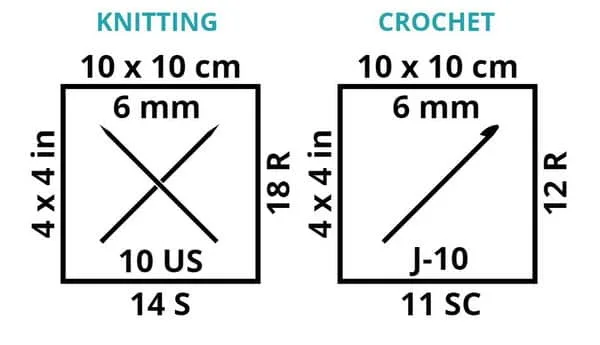
On the bottom of the symbol is the recommended stitch gauge and on the right is the recommend row gauge.
The average knitter should be able to achieve this gauge using the needle size displayed in the center of the symbol.
So you would want to find a yarn that has a similar stitch gauge to the one you want to substitute.
This is going to give you a MUCH better result versus the CYC number system.
HOWEVER…
It’s a lot more work to search through data bases or yarn labels to find a suitable substitute using this method.
And not all yarn ball bands use these specific symbols. Many offer a gauge range depending on what needle size you’re using.
So if you’re using a yarn from a boutique yarn company you’ll have a harder time using this method.
But there is a better ways that can be used with any yarn!
The BEST way to find a yarn substitute
I discovered this method when I created my first yarn line.
When I told the guy at the mill I wanted a medium weight yarn he said he didn’t know what that meant.
They determine yarn weight using this number; yards per gram.
What you do is you divide the yardage (or meters) by the weight in grams.
So if your yarn had a yardage of 220 yd per 100g your yardage per gram is 2.2.
Now any yarn that is relatively close to your yd/g number will be a perfect substitute (say within .25 yds or so).
I illustrate the process in the video below:
The benefit of this method is it works REGARDLESS of the fiber composition of your yarn.
It doesn’t matter if you want to swap out an organic cotton silk yarn for a 100% merino wool. You’ll have a pretty close match every time.
The only drawback to this method is you have to do some research to find the yardage and weight numbers.
But I’d say its worth it to get the perfect substitute.
And if you need some help finding a starting point, Yarnsub.com is a great resource.
Conclusion
So there you have it.
We think this is the best method for substituting yarn.
But what do you think?
Have you tried substituting yarn in a pattern?
What was your experience?
Hit reply and share your experience with us!
We’d love to hear your feedback. 😊